
Choosing a system
One-Piece and Two-Piece Ostomy Systems Explained
Compare one-piece and two-piece ostomy systems, understand how they work, and learn what to discuss with your ostomy nurse.
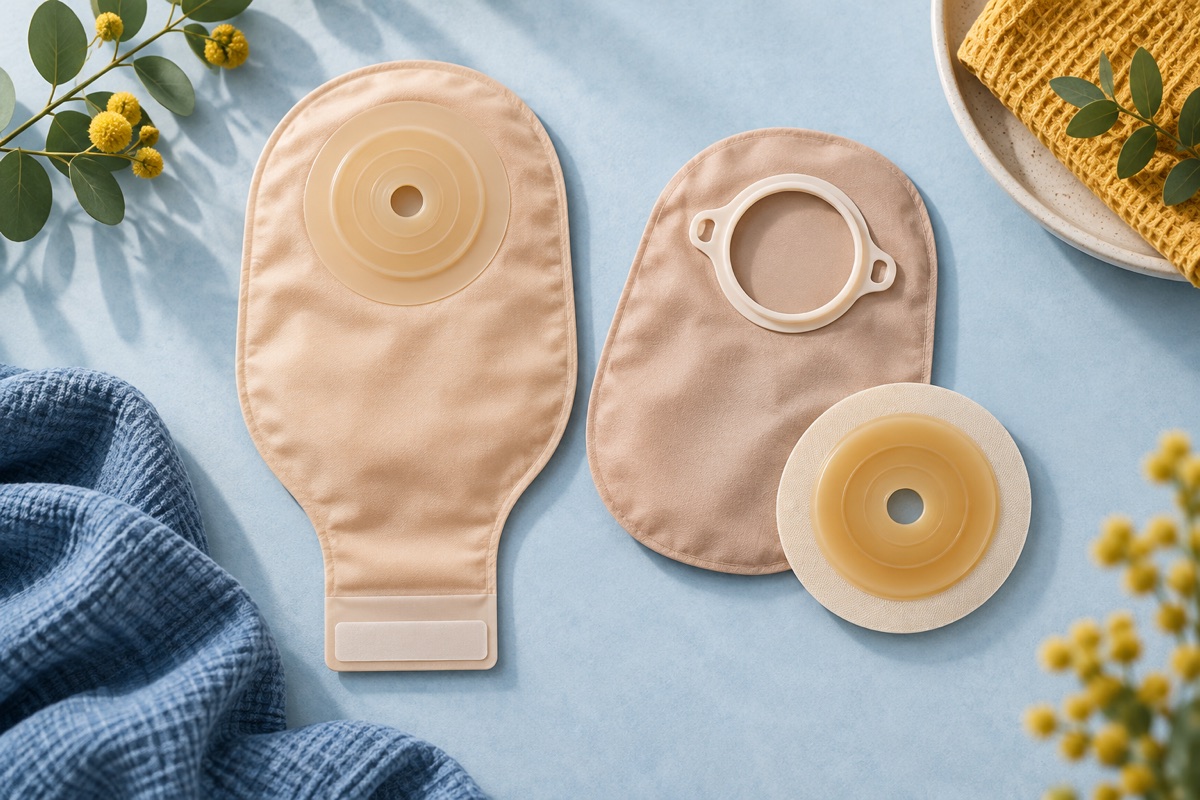
Illustrative image. Product shapes and features vary.
Choosing an ostomy system becomes easier when you understand its two main parts. The skin barrier adheres to your abdomen and protects the skin around your stoma. The pouch collects stool or urine. In a one-piece system, those parts stay together. In a two-piece system, they connect separately.
How a one-piece system works
The pouch and barrier are permanently joined, so you remove both when changing the complete system. Some people appreciate having fewer separate components to handle. Depending on its design, a one-piece system can also have a low profile under clothing.
A one-piece drainable pouch can still be emptied through its outlet while you are wearing it. “One-piece” describes how the pouch and barrier are joined; it does not mean you need a new system every time you empty it.
How a two-piece system works
The pouch attaches to a separate barrier through a compatible coupling. This can allow you to replace the pouch while leaving a well-fitting barrier in place. The attachment may use a mechanical connection or an adhesive coupling, depending on the product.
The extra connection is something you need to be comfortable handling and checking. Follow the manufacturer's instructions and confirm that the pouch is fully secured.
| Feature | One-piece | Two-piece |
|---|---|---|
| Pouch and barrier | Permanently joined | Separate compatible components |
| Complete system change | Pouch and barrier removed together | Pouch can detach from barrier |
| What to practise | Positioning the combined system | Positioning and securing the coupling |
Choose for your body and daily routine
Your stoma, abdominal shape, skin, eyesight, hand strength, and preferences all matter. Ask your NSWOC to help you assess a sample rather than choosing solely from a product photograph. A useful trial looks at comfort, ease of emptying, skin condition, and how reliably the seal holds.
For two-piece products, check the exact product family and coupling size before ordering. A matching measurement alone does not establish compatibility between different systems.
Before your next order: Keep a photo of your product labels and the product numbers your care team recommends. Use those details when comparing supplies on OstomySale.ca.
General education only. Follow your care team's advice and the instructions for your specific products. An NSWOC (Nurse Specialized in Wound, Ostomy and Continence) can help assess your individual needs.
Sources & further reading
- Hollister Canada — What You Need to Know About Ostomy Pouching Systems
- NSWOCC — A Guide to Living with a Colostomy
Back to Articles & Advice · Questions about ordering? Contact us